May this New Year adorn your life with many beautiful things and sweet memories to cherish forever.
And care of those whom the heart holds close, along with abundant joys and happiness, for you and your family.
Wishing you life's best this New Year.

About Me

- L.S.
- ГБОУ Гимназия №1542, г. Москва учитель английского языка, победитель конкурса педагогического мастерства ГРАНТ МОСКВЫ 2010, победитель Всероссийского конкурса социальных проектов 2010 - Педсовет,RU, Победитель Всероссийского конкурса iУчитель 2019, Грант МЭШ 2019.
Thursday, December 30


Tuesday, December 14
Christmas
'Twas The Night Before Christmas: Reading Comprehension
This week's reading comprehension is based on "'Twas The Night Before Christmas" which is one of the most traditional Christmas readings in English speaking countries. Written in 1822 by Clement C. Moore, "'Twas The Night Before Christmas" tells the story of Santa's arrival on Christmas Eve at a typical American household. Imagine it is Christmas Eve and you are sitting around the fireplace drinking a nice cup of Egg Nog (a typical Christmas drink made with eggs, cinnamon, milk and other ingredients sometimes including a good bit of rum) anxiously awaiting Christmas Eve. Outside the snow is falling and all the family is together. Finally, someone in the family takes out "'Twas The Night Before Christmas"
Before reading you may want to review some of the more difficult vocabulary listed after the story.
'Twas The Night Before Christmas, when all through the house
Not a creature was stirring, not even a mouse;
The stockings were hung by the chimney with care,
In hopes that St. Nicholas soon would be there;
The children were nestled all snug in their beds,
While visions of sugar-plums danced in their heads;
And mamma in her 'kerchief, and I in my cap,
Had just settled down for a long winter's nap,
When out on the lawn there arose such a clatter,
I sprang from the bed to see what was the matter.
Away to the window I flew like a flash,
Tore open the shutters and threw up the sash.
The moon on the breast of the new-fallen snow
Gave the lustre of mid-day to objects below,
When, what to my wondering eyes should appear,
But a miniature sleigh, and eight tiny reindeer,
With a little old driver, so lively and quick,
I knew in a moment it must be St. Nick.
More rapid than eagles his coursers they came,
And he whistled, and shouted, and called them by name;
"Now, Dasher! now, Dancer! now, Prancer and Vixen!
On, Comet! on Cupid! on, Donder and Blitzen!
To the top of the porch! to the top of the wall!
Now dash away! dash away! dash away all!"
As dry leaves that before the wild hurricane fly,
When they meet with an obstacle, mount to the sky,
So up to the house-top the coursers they flew,
With the sleigh full of toys, and St. Nicholas too.
And then, in a twinkling, I heard on the roof
The prancing and pawing of each little hoof.
As I drew in my hand, and was turning around,
Down the chimney St. Nicholas came with a bound.
He was dressed all in fur, from his head to his foot,
And his clothes were all tarnished with ashes and soot;
A bundle of toys he had flung on his back,
And he looked like a peddler just opening his pack.
His eyes -- how they twinkled! his dimples how merry!
His cheeks were like roses, his nose like a cherry!
His droll little mouth was drawn up like a bow,
And the beard of his chin was as white as the snow;
The stump of a pipe he held tight in his teeth,
And the smoke it encircled his head like a wreath;
He had a broad face and a little round belly,
That shook, when he laughed like a bowlful of jelly.
He was chubby and plump, a right jolly old elf,
And I laughed when I saw him, in spite of myself;
A wink of his eye and a twist of his head,
Soon gave me to know I had nothing to dread;
He spoke not a word, but went straight to his work,
And filled all the stockings; then turned with a jerk,
And laying his finger aside of his nose,
And giving a nod, up the chimney he rose;
He sprang to his sleigh, to his team gave a whistle,
And away they all flew like the down of a thistle.
But I heard him exclaim, ere he drove out of sight,
"Happy Christmas to all, and to all a good-night."
The vocabulary is in the order it appears in "'Twas The Night Before Christmas"
'Twas = It was
stirring = movement
nestled = comfortably in place
'kerchief = handkerchief
clatter = noise
sash = window covering that is pulled down from inside the room
shutters = window covering that is opened from outside the window
lustre = glow, illumination
sleigh = Santa Claus' vehicle, also used in Alaska with dogs
St. Nick = Santa Claus
Coursers = Animals which draw a sleigh
Porch = terrace
dash away = move onwards quickly
twinkling = a second
bound = a jump
tarnished = dirty
soot = black waste material found inside a chimney
bundle = bag
peddler = someone who sells things on the street
dimples = indentations on the cheeks
merry = happy
droll = funny
encircled = circle around
belly = stomach
dread = to be afraid of
jerk = quick movement
down of a thistle = the light material on a certain type of weed that floats away in the air
ere = before
I hope you enjoyed this traditional Christmas story. Here are some comprehension questions based on the story:
'Twas the Night Before Christmas QuizBefore reading you may want to review some of the more difficult vocabulary listed after the story.
'Twas The Night Before Christmas, when all through the house
Not a creature was stirring, not even a mouse;
The stockings were hung by the chimney with care,
In hopes that St. Nicholas soon would be there;
The children were nestled all snug in their beds,
While visions of sugar-plums danced in their heads;
And mamma in her 'kerchief, and I in my cap,
Had just settled down for a long winter's nap,
When out on the lawn there arose such a clatter,
I sprang from the bed to see what was the matter.
Away to the window I flew like a flash,
Tore open the shutters and threw up the sash.
The moon on the breast of the new-fallen snow
Gave the lustre of mid-day to objects below,
When, what to my wondering eyes should appear,
But a miniature sleigh, and eight tiny reindeer,
With a little old driver, so lively and quick,
I knew in a moment it must be St. Nick.
More rapid than eagles his coursers they came,
And he whistled, and shouted, and called them by name;
"Now, Dasher! now, Dancer! now, Prancer and Vixen!
On, Comet! on Cupid! on, Donder and Blitzen!
To the top of the porch! to the top of the wall!
Now dash away! dash away! dash away all!"
As dry leaves that before the wild hurricane fly,
When they meet with an obstacle, mount to the sky,
So up to the house-top the coursers they flew,
With the sleigh full of toys, and St. Nicholas too.
And then, in a twinkling, I heard on the roof
The prancing and pawing of each little hoof.
As I drew in my hand, and was turning around,
Down the chimney St. Nicholas came with a bound.
He was dressed all in fur, from his head to his foot,
And his clothes were all tarnished with ashes and soot;
A bundle of toys he had flung on his back,
And he looked like a peddler just opening his pack.
His eyes -- how they twinkled! his dimples how merry!
His cheeks were like roses, his nose like a cherry!
His droll little mouth was drawn up like a bow,
And the beard of his chin was as white as the snow;
The stump of a pipe he held tight in his teeth,
And the smoke it encircled his head like a wreath;
He had a broad face and a little round belly,
That shook, when he laughed like a bowlful of jelly.
He was chubby and plump, a right jolly old elf,
And I laughed when I saw him, in spite of myself;
A wink of his eye and a twist of his head,
Soon gave me to know I had nothing to dread;
He spoke not a word, but went straight to his work,
And filled all the stockings; then turned with a jerk,
And laying his finger aside of his nose,
And giving a nod, up the chimney he rose;
He sprang to his sleigh, to his team gave a whistle,
And away they all flew like the down of a thistle.
But I heard him exclaim, ere he drove out of sight,
"Happy Christmas to all, and to all a good-night."
The vocabulary is in the order it appears in "'Twas The Night Before Christmas"
'Twas = It was
stirring = movement
nestled = comfortably in place
'kerchief = handkerchief
clatter = noise
sash = window covering that is pulled down from inside the room
shutters = window covering that is opened from outside the window
lustre = glow, illumination
sleigh = Santa Claus' vehicle, also used in Alaska with dogs
St. Nick = Santa Claus
Coursers = Animals which draw a sleigh
Porch = terrace
dash away = move onwards quickly
twinkling = a second
bound = a jump
tarnished = dirty
soot = black waste material found inside a chimney
bundle = bag
peddler = someone who sells things on the street
dimples = indentations on the cheeks
merry = happy
droll = funny
encircled = circle around
belly = stomach
dread = to be afraid of
jerk = quick movement
down of a thistle = the light material on a certain type of weed that floats away in the air
ere = before
I hope you enjoyed this traditional Christmas story. Here are some comprehension questions based on the story:
http://esl.about.com/library/quiz/bl-christmas-quiz2.htm
Sunday, December 12
Conditional Forms
Conditional Forms
Listed below are examples, uses and formation of Conditionals followed by a quiz.
Conditional 0
Situations those are always true if something happens.
Note
This use is similar to, and can usually be replaced by, a time clause using 'when' (example: When I am late, my father takes me to school.)
If I am late, my father takes me to school.
She doesn't worry if Jack stays out after school.
She doesn't worry if Jack stays out after school.
Conditional 0 is formed by the use of the present simple in the if clause followed by a comma the present simple in the result clause. You can also put the result clause first without using a comma between the clauses.
If he comes to town, we have dinner.
OR
We have dinner if he comes to town.
OR
We have dinner if he comes to town.
Conditional 1
Often called the "real" conditional because it is used for real - or possible - situations. These situations take place if a certain condition is met.
note
In the conditional 1 we often use unless which means 'if ... not'. In other words, '...unless he hurries up.' could also be written, '...if he doesn't hurry up.'.
If it rains, we will stay at home.
He will arrive late unless he hurries up.
Peter will buy a new car, if he gets his raise.
He will arrive late unless he hurries up.
Peter will buy a new car, if he gets his raise.
Conditional 1 is formed by the use of the present simple in the if clause followed by a comma will verb (base form) in the result clause. You can also put the result clause first without using a comma between the clauses.
If he finishes on time, we will go to the movies.
OR
We will go to the movies if he finishes on time.
OR
We will go to the movies if he finishes on time.
Conditional 2
Often called the "unreal" conditional because it is used for unreal - impossible or improbable - situations. This conditional provides an imaginary result for a given situation.
NOTE
The verb 'to be', when used in the 2nd conditional, is always conjugated as 'were'.
If he studied more, he would pass the exam.
I would lower taxes if I were the President.
They would buy a new house if they had more money.
I would lower taxes if I were the President.
They would buy a new house if they had more money.
Conditional 2 is formed by the use of the past simple in the if clause followed by a comma would verb (base form) in the result clause. You can also put the result clause first without using a comma between the clauses.
If they had more money, they would buy a new house.
OR
They would buy a new house if they had more money.
OR
They would buy a new house if they had more money.
Conditional 3
Often referred to as the "past" conditional because it concerns only past situations with hypothetical results. Used to express a hypothetical result to a past given situation.
If he had known that, he would have decided differently.
Jane would have found a new job if she had stayed in Boston.
Jane would have found a new job if she had stayed in Boston.
Conditional 3 is formed by the use of the past perfect in the if clause followed by a comma would have past participle in the result clause. You can also put the result clause first without using a comma between the clauses.
If Alice had won the competition, life would have changed OR Life would have changed if Alice had won the competition.
Wednesday, October 27
Halloween
Halloween

Did You Know?
One quarter of all the candy sold annually in the U.S. is purchased for Halloween.
Halloween, celebrated each year on October 31, is a mix of ancient Celtic practices, Catholic and Roman religious rituals and European folk traditions that blended together over time to create the holiday we know today. Straddling the line between fall and winter, plenty and paucity and life and death, Halloween is a time of celebration and superstition. Halloween has long been thought of as a day when the dead can return to the earth, and ancient Celts would light bonfires and wear costumes to ward off these roaming ghosts. The Celtic holiday of Samhain, the Catholic Hallowmas period of All Saints' Day and All Souls' Day and the Roman festival of Feralia all influenced the modern holiday of Halloween. In the 19th century, Halloween began to lose its religious connotation, becoming a more secular community-based children's holiday. Although the superstitions and beliefs surrounding Halloween may have evolved over the years, as the days grow shorter and the nights get colder, people can still look forward to parades, costumes and sweet treats to usher in the winter season.
Ancient Origins of Halloween
Halloween's origins date back to the ancient Celtic festival of Samhain (pronounced sow-in).
The Celts, who lived 2,000 years ago in the area that is now Ireland, the United Kingdom, and northern France, celebrated their new year on November 1. This day marked the end of summer and the harvest and the beginning of the dark, cold winter, a time of year that was often associated with human death. Celts believed that on the night before the new year, the boundary between the worlds of the living and the dead became blurred. On the night of October 31, they celebrated Samhain, when it was believed that the ghosts of the dead returned to earth. In addition to causing trouble and damaging crops, Celts thought that the presence of the otherworldly spirits made it easier for the Druids, or Celtic priests, to make predictions about the future. For a people entirely dependent on the volatile natural world, these prophecies were an important source of comfort and direction during the long, dark winter.
To commemorate the event, Druids built huge sacred bonfires, where the people gathered to burn crops and animals as sacrifices to the Celtic deities.
During the celebration, the Celts wore costumes, typically consisting of animal heads and skins, and attempted to tell each other's fortunes. When the celebration was over, they re-lit their hearth fires, which they had extinguished earlier that evening, from the sacred bonfire to help protect them during the coming winter.
By A.D. 43, Romans had conquered the majority of Celtic territory. In the course of the four hundred years that they ruled the Celtic lands, two festivals of Roman origin were combined with the traditional Celtic celebration of Samhain.
The first was Feralia, a day in late October when the Romans traditionally commemorated the passing of the dead. The second was a day to honor Pomona, the Roman goddess of fruit and trees. The symbol of Pomona is the apple and the incorporation of this celebration into Samhain probably explains the tradition of "bobbing" for apples that is practiced today on Halloween.
By the 800s, the influence of Christianity had spread into Celtic lands. In the seventh century, Pope Boniface IV designated November 1 All Saints' Day, a time to honor saints and martyrs. It is widely believed today that the pope was attempting to replace the Celtic festival of the dead with a related, but church-sanctioned holiday. The celebration was also called All-hallows or All-hallowmas (from Middle English Alholowmesse meaning All Saints' Day) and the night before it, the night of Samhain, began to be called All-hallows Eve and, eventually, Halloween. Even later, in A.D. 1000, the church would make November 2 All Souls' Day, a day to honor the dead. It was celebrated similarly to Samhain, with big bonfires, parades, and dressing up in costumes as saints, angels, and devils. Together, the three celebrations, the eve of All Saints', All Saints', and All Souls', were called Hallowmas.
Halloween Comes to America
As European immigrants came to America, they brought their varied Halloween customs with them. Because of the rigid Protestant belief systems that characterized early New England, celebration of Halloween in colonial times was extremely limited there.
It was much more common in Maryland and the southern colonies. As the beliefs and customs of different European ethnic groups, as well as the American Indians, meshed, a distinctly American version of Halloween began to emerge. The first celebrations included "play parties," public events held to celebrate the harvest, where neighbors would share stories of the dead, tell each other's fortunes, dance, and sing. Colonial Halloween festivities also featured the telling of ghost stories and mischief-making of all kinds. By the middle of the nineteenth century, annual autumn festivities were common, but Halloween was not yet celebrated everywhere in the country.
In the second half of the nineteenth century, America was flooded with new immigrants. These new immigrants, especially the millions of Irish fleeing Ireland's potato famine of 1846, helped to popularize the celebration of Halloween nationally. Taking from Irish and English traditions, Americans began to dress up in costumes and go house to house asking for food or money, a practice that eventually became today's "trick-or-treat" tradition. Young women believed that, on Halloween, they could divine the name or appearance of their future husband by doing tricks with yarn, apple parings, or mirrors.
In the late 1800s, there was a move in America to mold Halloween into a holiday more about community and neighborly get-togethers, than about ghosts, pranks, and witchcraft.
At the turn of the century, Halloween parties for both children and adults became the most common way to celebrate the day. Parties focused on games, foods of the season, and festive costumes. Parents were encouraged by newspapers and community leaders to take anything "frightening" or "grotesque" out of Halloween celebrations. Because of their efforts, Halloween lost most of its superstitious and religious overtones by the beginning of the twentieth century.
By the 1920s and 1930s, Halloween had become a secular, but community-centered holiday, with parades and town-wide parties as the featured entertainment. Despite the best efforts of many schools and communities, vandalism began to plague Halloween celebrations in many communities during this time. By the 1950s, town leaders had successfully limited vandalism and Halloween had evolved into a holiday directed mainly at the young. Due to the high numbers of young children during the fifties baby boom, parties moved from town civic centers into the classroom or home, where they could be more easily accommodated. Between 1920 and 1950, the centuries-old practice of trick-or-treating was also revived. Trick-or-treating was a relatively inexpensive way for an entire community to share the Halloween celebration. In theory, families could also prevent tricks being played on them by providing the neighborhood children with small treats. A new American tradition was born, and it has continued to grow. Today, Americans spend an estimated $6.9 billion annually on Halloween, making it the country's second largest commercial holiday.
Today's Traditions
The American Halloween tradition of "trick-or-treating" probably dates back to the early All Souls' Day parades in England. During the festivities, poor citizens would beg for food and families would give them pastries called "soul cakes" in return for their promise to pray for the family's dead relatives.The distribution of soul cakes was encouraged by the church as a way to replace the ancient practice of leaving food and wine for roaming spirits. The practice, which was referred to as "going a-souling" was eventually taken up by children who would visit the houses in their neighborhood and be given ale, food, and money.
The tradition of dressing in costume for Halloween has both European and Celtic roots. Hundreds of years ago, winter was an uncertain and frightening time. Food supplies often ran low and, for the many people afraid of the dark, the short days of winter were full of constant worry. On Halloween, when it was believed that ghosts came back to the earthly world, people thought that they would encounter ghosts if they left their homes. To avoid being recognized by these ghosts, people would wear masks when they left their homes after dark so that the ghosts would mistake them for fellow spirits. On Halloween, to keep ghosts away from their houses, people would place bowls of food outside their homes to appease the ghosts and prevent them from attempting to enter.
Superstitions
Halloween has always been a holiday filled with mystery, magic and superstition. It began as a Celtic end-of-summer festival during which people felt especially close to deceased relatives and friends. For these friendly spirits, they set places at the dinner table, left treats on doorsteps and along the side of the road and lit candles to help loved ones find their way back to the spirit world.
Today's Halloween ghosts are often depicted as more fearsome and malevolent, and our customs and superstitions are scarier too. We avoid crossing paths with black cats, afraid that they might bring us bad luck. This idea has its roots in the Middle Ages, when many people believed that witches avoided detection by turning themselves into cats. We try not to walk under ladders for the same reason. This superstition may have come from the ancient Egyptians, who believed that triangles were sacred; it also may have something to do with the fact that walking under a leaning ladder tends to be fairly unsafe. And around Halloween, especially, we try to avoid breaking mirrors, stepping on cracks in the road or spilling salt.
But what about the Halloween traditions and beliefs that today's trick-or-treaters have forgotten all about? Many of these obsolete rituals focused on the future instead of the past and the living instead of the dead. In particular, many had to do with helping young women identify their future husbands and reassuring them that they would someday--with luck, by next Halloween!--be married.
In 18th-century Ireland, a matchmaking cook might bury a ring in her mashed potatoes on Halloween night, hoping to bring true love to the diner who found it. In Scotland, fortune-tellers recommended that an eligible young woman name a hazelnut for each of her suitors and then toss the nuts into the fireplace. The nut that burned to ashes rather than popping or exploding, the story went, represented the girl's future husband. (In some versions of this legend, confusingly, the opposite was true: The nut that burned away symbolized a love that would not last.) Another tale had it that if a young woman ate a sugary concoction made out of walnuts, hazelnuts and nutmeg before bed on Halloween night, she would dream about her future husband. Young women tossed apple-peels over their shoulders, hoping that the peels would fall on the floor in the shape of their future husbands' initials; tried to learn about their futures by peering at egg yolks floating in a bowl of water; and stood in front of mirrors in darkened rooms, holding candles and looking over their shoulders for their husbands' faces.
Other rituals were more competitive. At some Halloween parties, the first guest to find a burr on a chestnut-hunt would be the first to marry; at others, the first successful apple-bobber would be the first down the aisle.
Of course, whether we're asking for romantic advice or trying to avoid seven years of bad luck, each one of these Halloween superstitions relies on the good will of the very same "spirits" whose presence the early Celts felt so keenly. Ours is not such a different holiday after all!
Wednesday, September 15
Color Poems
Orange
Orange is a carrot
And the orange I eat
Orange are these bright new socks
I wear upon my feet!
And the orange I eat
Orange are these bright new socks
I wear upon my feet!
Yellow
Yellow is a lemon
Yellow is a star
Yellow is the sun
In the sky so far
Yellow is a star
Yellow is the sun
In the sky so far
Red
Red is an apple
Red is a rose
Red is the color of
My frozen, icy nose!
Red is a rose
Red is the color of
My frozen, icy nose!
Green
Green is the grass
Under both my feet
And green is the broccoli
My mother makes me eat!
Under both my feet
And green is the broccoli
My mother makes me eat!
Black
Black is the night
And a witch's hat
Black is my Mom's hair
And that witch's cat!
And a witch's hat
Black is my Mom's hair
And that witch's cat!
Blue
Blue is the ocean
Blue are my eyes
Blue is the sky where
The lonely eagle flies.
Blue are my eyes
Blue is the sky where
The lonely eagle flies.
Brown
Brown is the mud
Brown is the bear
Brown is the color
Of my brother's hair.
Red Is An AppleBrown is the bear
Brown is the color
Of my brother's hair.

Red is an apple
on a tree.
Yellow is the sun shining on me.
Orange is the umbrella
over my head.
Green is the leaf
on a twig.
Blue is the ocean
oh, so big.
Grey is an elephant
I like to ride.
Pink is the flower
I see outside.
Brown is a rabbit
in a hat.
White is white
and that is that!
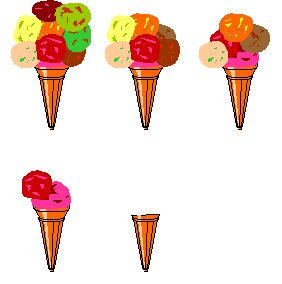
Thursday, September 9
The art of painting
The art of painting | |
 |  |
 Pablo Picasso was the outstanding innovator, responsible for the definitive transition from figurative painting to abstract painting. Around 1910 he and Georges Braque formulated a pictorial language now known as cubism, a style which still relied on nature's examples, but deformed in such a way that it opened the door to pure abstract art. Piet Mondrian, who contributed to the development of cubism and Kazimir Malivich, who also went through a cubist phase, were among the first to paint in a purely abstract style. Mondrian's neo-plasticism and Malivich's suprematism, have in common that these styles are both expressions of geometric abstraction, a style of abstract painting which uses geometric objects such as squares, rectangles and circles only. In Mondrian's case these would be rectangles and Malevich was particularly fond of the square, 'the zero of form', as he called it. Another important precursor to geometric abstraction is futurism, an Italy based artistic movement, which, as far as abstract painting is concerned, elaborated on cubism by adding an illusion of movement and dynamism which was typical of the futurists (rather polemic) intentions and temperament. To Malevich futurism was still too naturalistic and bewteen 1913 and 1915 he created his suprematism, which greatly influenced Piet Mondrian and his art-movement "De Stijl". | |
Friday, August 27
Back to school joke
I Didn't Do My Homework Because... Author - Victoria Abreo
*I didn't do my history homework because I don't believe in dwelling on the past.
*I didn't want the other kids in the class to look bad.
*A sudden gust of wind blew my homework out of my hand and I never saw it again.
*Our furnace broke and we had to burn my homework to keep ourselves from freezing.
*It was destroyed in a freak accident involving a hippo, a toaster, and a bag of frozen peas. You don't want to know the details.
*I have a solar-powered calculator, and it was cloudy.
*My agent won't allow me to publish my homework until the movie deal is finalized.
*I was abducted by green-skinned, three-eyed, pig-snouted space aliens, and they incinerated my homework with their death rays.
*My parents were sick and unable to do my homework last night. Don't worry, they have been suitably punished.
*We had homework?!
*I didn't want to add to your already heavy workload.
And I'm sure you will do all your homework this year or make up better reasons for not doing it... L.V.
Subscribe to:
Comments (Atom)